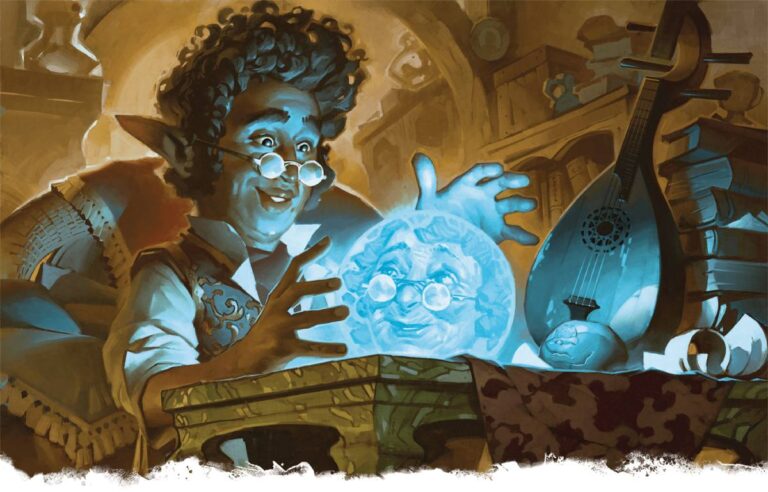
Halfling
HALFLINGS
Halflings are clever, capable opportunists. Halfling individuals and clans find room for themselves wherever they can. Often they are strangers and wanderers, and others react to them with suspicion or curiosity. Depending on the clan, halflings might be reliable, hard-working (if clannish) citizens, or they might be thieves just waiting for the opportunity to make a big score and disappear in the dead of night. Regardless, halflings are cunning, resourceful survivors.
Personality: Halflings prefer trouble to boredom. They are notoriously curious. Relying on their ability to survive or escape danger, they demonstrate a daring that many larger people can’t match. Halflings clans are nomadic, wandering wherever circumstance and curiosity take them. Halflings enjoy wealth and the pleasure it can bring, and they tend to spend gold as quickly as they acquire it. Halflings are also famous collectors. While more orthodox halflings may collect weapons, books, or jewelry, some collect such objects as the hides of wild beasts – or even the beasts themselves. Wealthy halflings sometimes commission adventurers to retrieve exotic items to complete their collections.
Physical Description: Halflings stand about 3 feet tall and usually weigh between 30 and 35 pounds. Their skin is ruddy, their hair black and straight. They have brown or black eyes. Halfling men often have long sideburns, but beards are rare among them and mustaches almost unseen. They like to wear simple, comfortable, and practical clothes. A halfling reaches adulthood at the age of 20 and generally lives into the middle of her second century.
Relations: Halflings try to get along with everyone else. They are adept at fitting into a community of humans, dwarves, elves, or gnomes and making themselves valuable and welcome. Since human society changes faster than the societies of the longer-lived races, it is human society that most frequently offers halflings opportunities to exploit, and halflings are most often found in or around human lands.
Alignment: Halflings tend to be neutral. While they are comfortable with change (a chaotic trait), they also tend to rely on intangible constants, such as clan ties and personal honor (a lawful trait).
Halfling Lands: Halflings have no lands of their own. Instead, they live in the lands of other races, where they can benefit from whatever resources those lands have to offer. Halflings often form tight-knit communities in human or dwarven cities. While they work readily with others, they often make friends only their own kind. Halflings also settle into secluded places where they set up self-reliant villages. Halfling communities, however, are known for picking up and moving en masse to some place that offers a new opportunity, such as a new mine that has just opened, or to a land where a devastating war has made skilled workers hard to find. If these opportunities are temporary, the community may pick up and move again once the opportunity is gone, or once a better one presents itself. Some halfling communities, on the other hand, take to traveling as a way of life, driving wagons or guiding boats from place to place, and maintaining no permanent home.
Religion: The chief halfling deity is Yondalla, the Blessed One, protector of the halflings. Yondalla promises blessings and protection to those who heed her guidance, defend their clans, and cherish their families. Halflings also recognize countless small gods, which they say rule over individual villages, forests, rivers, lakes, and so on. They pay homage to these deities to ensure safe journeys as they travel from place to place.
Language: Halflings speak their own language, which uses the Common script. They write very little in their own language so, unlike dwarves, elves, and gnomes, they don’t have a rich body of written work. The halfling oral tradition, however, is very strong. While the Halfling language isn’t secret, halflings are loath to share it with others. Almost all halflings speak Common, since they use it to deal with the people in whose land they are living or through which they are traveling.
Names: A halfling has a given name, a family name, and possibly a nickname. It would seem that family names are nothing more than nicknames that stuck so well they have been passed down through the generations.
Male Names: Alton, Beau, Cade, Eldon, Garret, Lyle, Milo, Osborn, Roscoe, Wellby.
Female Names: Amaryllis, Charmaine, Cora, Euphemia, Jillian, Lavinia, Lidda, Merla, Portia, Seraphina, Verna.
Family Names: Brushgather, Goodbarrel, Greenbottle, Highhill, Hilltopple, Leagallow, Tealeaf, Thorngage, Tosscobble, Underbough.
Adventurers: Halflings often set out on their own to make their way in the world. Halfling adventurers are typically looking for a way to use their skills to gain wealth or status. The distinction between a halfling adventurer and a halfling out on her own looking for “a big score” can get blurry. For a halfling, adventuring is less of a career than an opportunity. While halfling opportunism can sometimes look like larceny or fraud to others, a halfling adventurer who learns to trust her fellows is worthy of trust in return.
HALFLING RACIAL TRAITS
- +2 Dexterity, -2 Strength: Halflings are quick, agile, and good with ranged weapons, but they are small and therefore not as strong as other humanoids.
- Small: As a Small creature, a halfling gains a +1 size bonus to Armor Class, a +1 size bonus on attack rolls, and a +4 size bonus on Hide checks, but she uses smaller weapons than humans use, and her lifting and carrying limits are three-quarters of those of a Medium character.
- Halfling base land speed is 20 feet.
- +2 racial bonus on Climb, Jump, and Move Silently checks: Halflings are agile, surefooted, and athletic.
- +1 racial bonus on all saving throws: Halflings are surprisingly capable of avoiding mishaps.
- +2 morale bonus on saving throws against fear. This bonus stacks with the halfling’s +1 bonus on saving throws in general.
- +1 racial bonus on attack rolls with thrown weapons and slings: Throwing and slinging stones is a universal sport among halflings, and they develop especially good aim.
- +2 racial bonus on Listen checks: Halflings have keen ears.
- Automatic Languages: Common and Halfling. Bonus Languages: Dwarven, Elven, Gnome, Goblin, and Orc. Smart halflings learn the languages of their friends and enemies.
- Favored Class: Rogue. A multiclass halfling’s rogue class does not count when determining whether she takes an experience point penalty for multiclassing. Halflings have long had to rely on stealth, wit, and skill, and the vocation of rogue comes naturally to them.
SUBRACES
The information above is for the lightfoot halfling, the most common halfling variety. There are two other major halfling subraces, which differ from lightfoot halflings as follows.
Tallfellow
Tallfellows are somewhat rare among halfling folk. Tallfellows are 4 feet tall or more and weigh between 30 and 35 pounds. They generally speak Elven in addition to Common and Halfling, and they greatly enjoy the company of elves.
Tallfellow Traits (Ex): These traits are in addition to the lightfoot halfling traits, except where noted.
- +2 racial bonus on Search, Spot, and Listen checks. Like an elf, a tallfellow who merely passes within 5 feet of a secret or concealed door is entitled to a Search check as though actively looking for it. This trait replaces the lightfoot’s +2 bonus on Listen checks.
- Tallfellows are less athletic than lightfoot halflings and do not have a racial bonus on Climb, Jump, and Move Silently checks.
Deep Halfling
These halflings are shorter and stockier than the more common lightfeet.
Deep halflings are about 2-1/2 tall and weigh between 30 and 35 pounds. Deep halflings take great pleasure in gems and fine masonry, often working as jewelers or stonecutters. They rarely mix with humans and elves but enjoy the company of dwarves and speak Dwarven fluently.
Deep Halfling Traits (Ex): These traits are in addition to the lightfoot halfling traits, except where noted.
- Darkvision out to 60 feet.
- Stonecunning: Like dwarves, deep halflings have a +2 racial bonus on checks to notice unusual stonework. Something that isn’t stone but that is disguised as stone also counts as unusual stonework. A deep halfling who merely comes within 10 feet of unusual stonework can make a check as though actively searching and can use the Search skill to find stonework traps as a rogue can. A deep halfling can also intuit depth, sensing the approximate distance underground as naturally as a human can sense which way is up.
- +2 racial bonus on Appraise checks and Craft checks that are related to stone or metal.
- Deep halflings are less athletic than lightfoot halflings and do not have a racial bonus on Climb, Jump, and Move Silently checks.